Real Vinicola Vintage Port 1982 (Tasted 2015)

GS6A6065

Real Vinicola has the longest continuous history of any of today’s producers of Duoro wines. Founded in 1889 under contract with the Portuguese government, it was entrusted with the task of selling wines from various regions in northern Portugal, including Duoro red wines and port wines.

They bought Quinta do Sibio in 1934 and has declared this as Single Quinta Vintage Port. Quinta do Sibio was known as Quinta do Jordão and was planted by Jose Joaquim Pereri Jordão in the 1860s and 1870s. The quinta was in the hands of the Jordão family until 1934 when Real Companhia Vinícola purchased it.

Real Vinicola was bought by Real Companhia Velha in 1963, but the quinta was still sold under the Real Vinicola label.

I bought this 750 ml bottle at 21% as part of a auction lot, this bottle was about 32 Euro.

It was decanted for 6 hours.

Light red see through with brown tones to the colour.

The aroma is dominated by the alcohol over a spiced dried fruits.

Tasting is warm, some tannin, a weak fruit and ends in the sweet end with a little peak of tannin.

By time the alcohol became less dominant and the taste was a bit more balanced, but not a great port.

Overall rating 85 / 100

Quinta De La Rosa Vintage Port 1990

GS6A6096

The Bergqvist family has been making port since 1815. Quinta de Ia Rosa was given as a christening present for Claire Feuheerd, Sophia’s grandmother, in 1906. The family port shipping company, Feueheerd, was sold in the 1930s but La Rosa was kept and run by Sophia’s grandmother, Claire. In 1988 Sophia and her father, Tim Bergqvist, decided to restart the family business and launched Quinta de Ia Rosa as a top quality port producer onto the market place.

GS6A6114GS6A6113

I have this 750 ml bottle at 20% from a auction lot. It is a rarely seen vintage year from Quinta De La Rosa.

2 hours in the decanter

Clear and light red colour with amber notes.

Aroma comes off with spices, warmth, dried fruits and they play between them is rather pleasant.

Tannin is strong and together with the alcohol it comes off rather hard in the start. It is more spiced than fruity and it is dry and fresh.

GS6A6117

4 hours in the decanter

It has darkened up a little bit.

The aroma is much more fruitful.

Taste is the same and tannin is still dominating.

8 hours in the decanter

No difference from the above.

GS6A6121

48 hours after decanting, on the bottle again

More fruit and some oak have started to shine through. Less tannin but it still comes off with a bite and the after taste is not overwhelming with dried fruits and sweetness.


I would say that it needs more than 8 hours in the decanter, the tannin are simply too rough and needs some more air to get the port to come better together. It is a very closed wine that needs some time and attention on when it is ready to drink.

I will save my last bottle of it for another 5 years and see how it is by then.

Overall rating 89 / 100


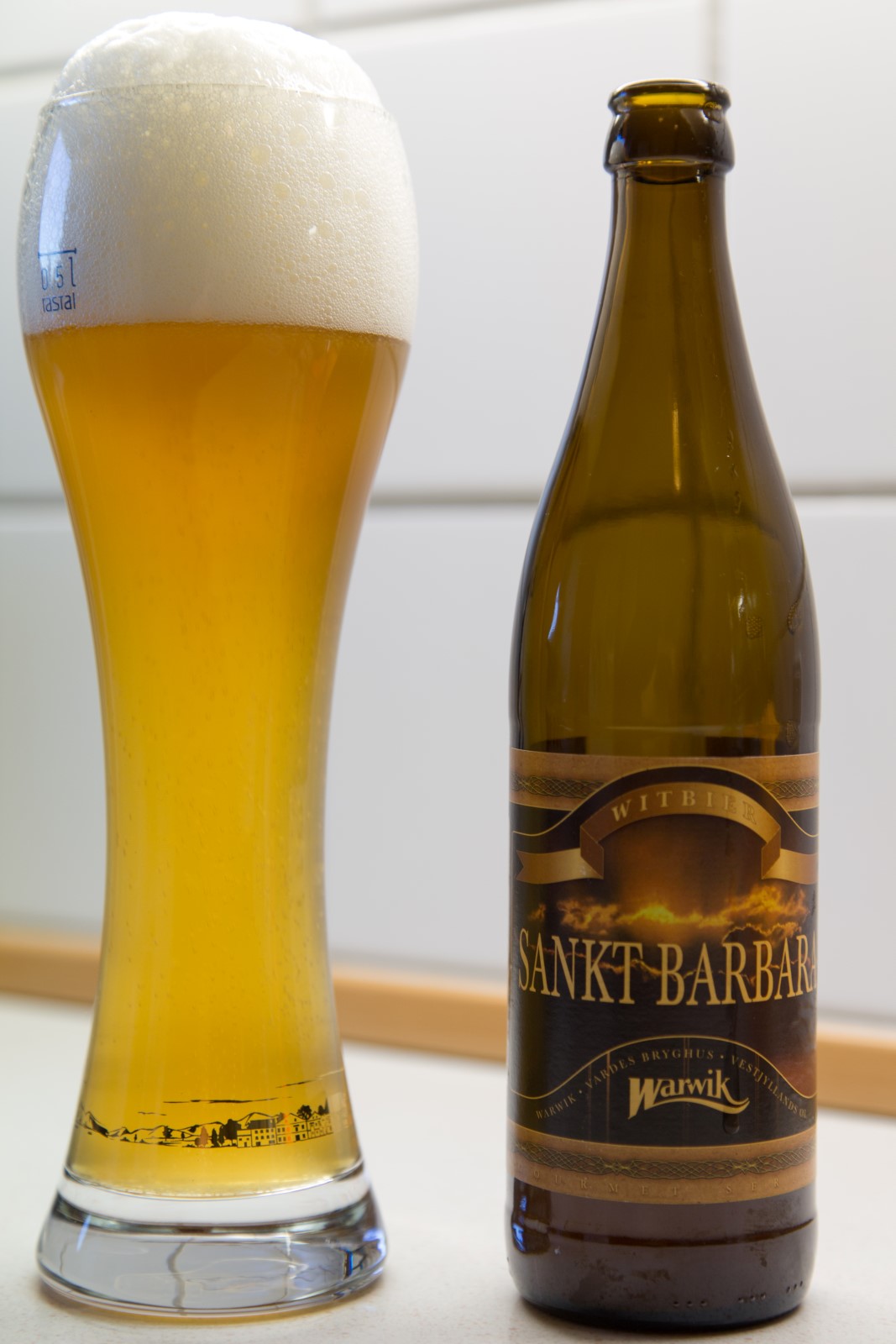
Warvik Vardes bryghus – Sankt Barbara

GS6A6082Warvik Vardes brewhouse was founded in 2004 and shares was sold one by one to everyone interested in owning a little part of the brewery and securing its future to stay in the town of Varde, Denmark.

I bought this witbier in a 500ml bottle at 5,1% in the wine shop Skjold Burne in Svendborg, Denmark at the price of 3,5 Euro.

A uniltered beer that is only lightly hazy and there are large pieces of sediment in the bottle.

Huge head with a real rough structure, leaves a fine layer behind.

Good sweet fruit in the aroma with a hint of hops.

Okay CO2, the fruit taste goes over in a more hoppy bitterness along with the light after taste.

Overall rating 74 / 100

Cigar City Brewing – Florida Cracker

GS6A6054

Cigar City Brewing was established in 2008 by Tampa native, Joey Redner, Jr. In early 2008, Redner met Wayne Wambles, accomplished professional brewer, and hired him as head brewmaster. Wayne relocated in March of 2008 to begin the process of learning the local culture, applying that culture to CCB’s beers, and opening this new microbrewery in Tampa, Florida

I bought this Belgian style white ale from the wine shop Vinoble in Odense, Denmark at the price of 4 Euro for a 12 oz (355 ml) can at 5,5%

A very bright yellow in the colour and only slightly hazy.

There was no head at all, any bubbles formed at pouring was gone in a second.

Good sweet fruit in the aroma.

Low CO2 but with a good fruit in the taste, there is a suitable play from the hops and spices.

CO2 was too low, no head and the taste can seem a little doll at the end.

Overall rating 76 / 100

Visiting Taylor’s in Porto

GS6A1744

The story of Taylor’s starts with Job Bearsley arriving in Porto in 1692, he was initially in the red wine trade. Job first born son Peter would also come to live in Porto and so did Peters three sons Bartholomew, Charles and Francis. Francis Bearsley outlived all his brothers and remained a partner in the Oporto house for 61 years from 1744 until his death in 1805.

After Francis’ death there was no suitable family members to run the business and those who tried failed and had to give in. In 1808, as Napoleon advanced in his war, it was clear that all property was better to not be on British hand, in the interest of preserving it.

A American descented from Turkey, John Camo would take over ownership and run the company from 1808 to 1812 where his largest challenges was getting shipments of port to Britain despite the war raging.

Joseph Taylor, who had already been in the London part of the business for a long while, took over the lead of company, he became sole owner in 1826. In 1835 he looked for successors and had Morgan Yeatman, a wine trader from Britain and John Fladgate a son of a contact in sight to run the company. John moved to  Oporto in 1836 and signed the contact with the new company name in 1838 with Morgan Yeatman. Taylor Fladgate & Yeatman. John focused on the wine making and Morgan on the business.

The rest of the story is even longer and should be read on Taylor’s own website

GS6A1745

The collection of old bottles that you will see at every port house.

GS6A1747A view of the very cask inspired and in casks constructed bar.

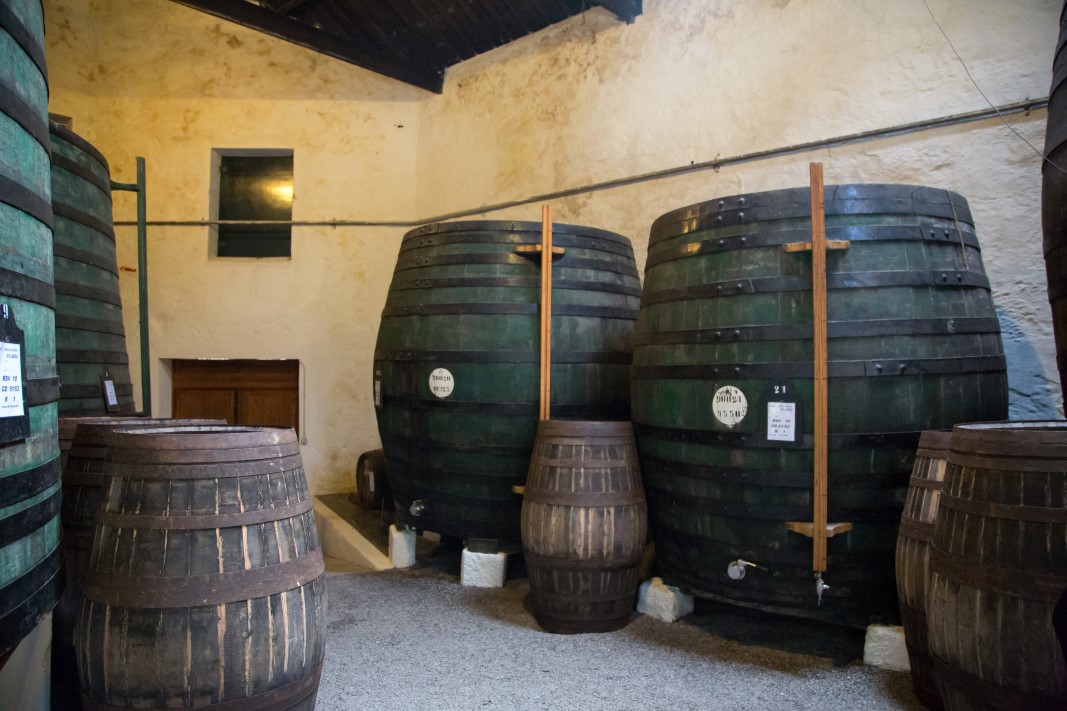
GS6A1748GS6A1750Taylor’s have a serious and stunning amount of large vats.

GS6A1752GS6A1753These vats hold around 6000 to 16000 Litre of port.

GS6A1754GS6A1756As long as the lodges are, just as long are the endless rows of casks.

GS6A1757The largest vat in Vila Nova de Gaia, holding in about 100000 Litre of port.

GS6A1759A view from the terrace around the bar. A view of the roofs of the many Taylor’s cellars.


Offley Colheita Porto 1997

GS6A5674Read all about Offley here: Visiting Offley in Porto

I was given this 750 ml bottle at 20% as a present, but it was bought in a Danish super market.

Red with brown notes in the colour, a deep amber and wood shine to it.

The aroma comes off with a heavy dried fruit scent and some alcohol makes it way through.

Spiced flavours, some tannin, different dried fruits in the taste that develops into a distinct  raisin in the after taste.

Overall rating 88 / 100

Visiting Offley in Porto

GS6A1761

Offley was founded in London in 1737 by William Offley, the company started out as a wine merchant, Offley was soon exporting wines and later began to produce its own Porto Wine.

Joseph James Forrester joined the company in the 1830’s and his entire adult life in Portugal was devoted to the Douro river and Porto Wine. Forrester was the first to chart the Douro River and Valley, an accomplishment that earned him recognition from and entry into various European Geography and Art societies.

Sogrape Vinhos merged with Forrester & Cª., Holder of Offley.

GS6A1762

Offley have very long and what seems to be endless cellars of casked port.

GS6A1764Some of the tunnels have a slightly lower temperature than those under the wooden roofs.

GS6A1765GS6A1766The large vats with 13000 Litre of Tawny port in each.

GS6A1767More casks with Tawny port.


Kongebryg – Hefeweizen

GS6A6053

Kongebryg brewery is located at a old military facility in Næstved, Denmark. It is a relatively new brewery and they use a 60 year old English Grundy brew equipment. All their beers are bottle fermented for a natural carbonization.

I bought this unfiltered weissbier from the wine shop Vinens Verden in Odense, Denmark at the price of 7 Euro for a 500ml bottle at 5%.

A thick and very hazy yellow and amber orange colour.

Rough head that quickly disperses into a thin layer.

Aroma is coming off with even parts wheat and fruit.

A lot of CO2 and a good thick fruit taste that becomes sweeter in the after taste.

Overall rating 81 / 100

Kopke Colheita Porto 1984

GS6A6046

Kopke was established in 1638 by Christiano Kopke and his son, Nicolau Kopke. The company was sold to the Bohane family, by the end of the 19th century, who tried to run it from London. The distance and the two World Wars disabled the control of the Company and they decided to sell it. In 1953 the Barros family bought the House of Kopke. In June 2006 it was sold and became a part of the SOGEVINUS Group.

I bought this 750ml bottle at 20% in Rema 1000 supermarket in Odense, Denmark at the price of 25 Euro.

This Kopke Colheita 1984 was bottled in 2014.

Brown colour with glaring stars of red in the tincture when seen against the candle.

Spices, dried fruits and a warm alcohol in the aroma.

A little bite from the tannin, warm and with some oak in the taste. A good dried fruits taste, sweet with raisins in the after taste that lasts a good while.

When first uncorked it is dominated by the alcohol and needs to breathe, no decanting, just needs to sit for half a day in bottle with level under the neck. That really works wonders on this cheap and to the price surprisingly good colheita, it mellows quickly over a few days, so enjoy it 1-2 days after opening.

Overall rating 89 / 100

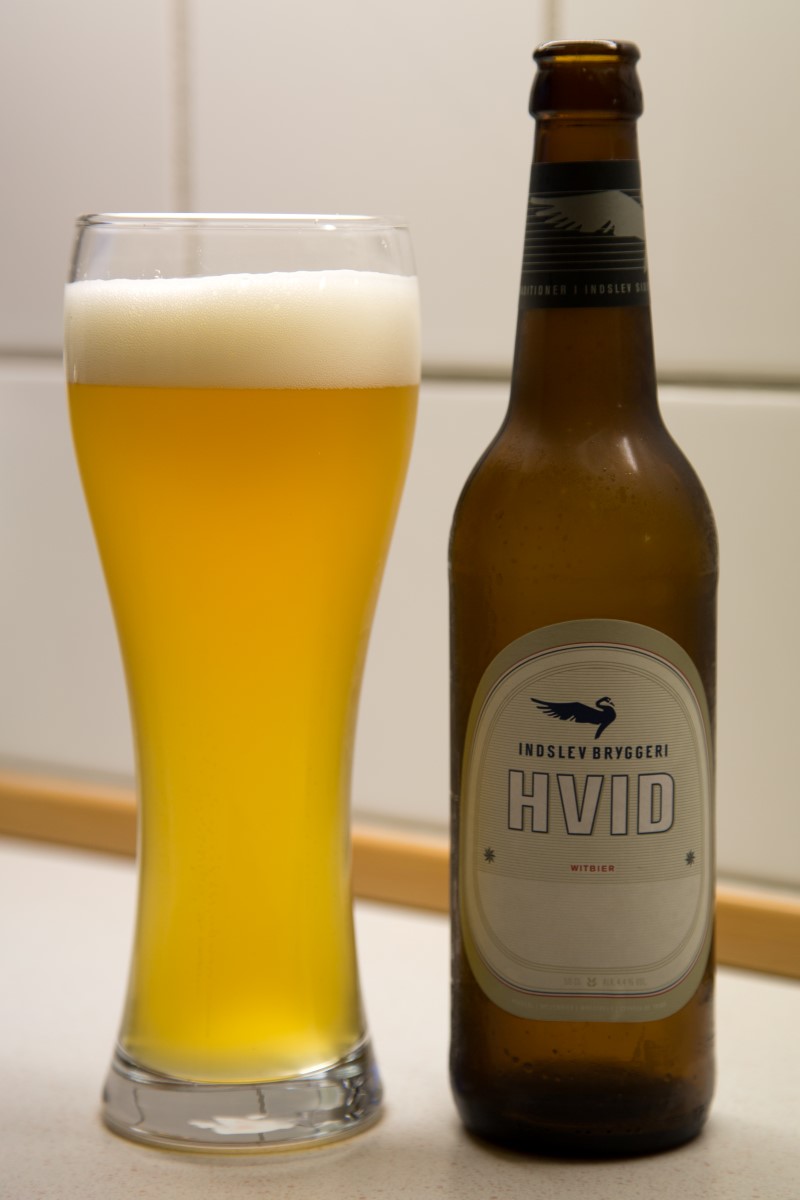
Indslev bryggeri – Hvid

GS6A5125

Indslev brewery was established in 1897 by Frederik Christian Rasmussen. At some point the brewery was closed down, but in 2005 restored to former glory with brand new production equipment. The re-opening was made possible by Anders Busse Rasmussen, grand grand nephew of Frederik Christian Rasmussen.

I bought this beer in a the super market Kvickly in Odense, Denmark at the price of 3 Euro for a 500ml bottle at 4,4%.

Light yellow in the colour with a white shine to it.

Medium sized head, super fine bubbles on the top and a thin layer stays on the beer.

Fresh fruit in the aroma with a hint of citrus.

Medium CO2 with a spiced flavour of fruit, fresh but also easy to drink.

Overall rating 77 / 100