Category Archives: Wine

Quinta De La Rosa Vintage Port 1990

GS6A6096

The Bergqvist family has been making port since 1815. Quinta de Ia Rosa was given as a christening present for Claire Feuheerd, Sophia’s grandmother, in 1906. The family port shipping company, Feueheerd, was sold in the 1930s but La Rosa was kept and run by Sophia’s grandmother, Claire. In 1988 Sophia and her father, Tim Bergqvist, decided to restart the family business and launched Quinta de Ia Rosa as a top quality port producer onto the market place.

GS6A6114GS6A6113

I have this 750 ml bottle at 20% from a auction lot. It is a rarely seen vintage year from Quinta De La Rosa.

2 hours in the decanter

Clear and light red colour with amber notes.

Aroma comes off with spices, warmth, dried fruits and they play between them is rather pleasant.

Tannin is strong and together with the alcohol it comes off rather hard in the start. It is more spiced than fruity and it is dry and fresh.

GS6A6117

4 hours in the decanter

It has darkened up a little bit.

The aroma is much more fruitful.

Taste is the same and tannin is still dominating.

8 hours in the decanter

No difference from the above.

GS6A6121

48 hours after decanting, on the bottle again

More fruit and some oak have started to shine through. Less tannin but it still comes off with a bite and the after taste is not overwhelming with dried fruits and sweetness.


I would say that it needs more than 8 hours in the decanter, the tannin are simply too rough and needs some more air to get the port to come better together. It is a very closed wine that needs some time and attention on when it is ready to drink.

I will save my last bottle of it for another 5 years and see how it is by then.

Overall rating 89 / 100


Visiting Taylor’s in Porto

GS6A1744

The story of Taylor’s starts with Job Bearsley arriving in Porto in 1692, he was initially in the red wine trade. Job first born son Peter would also come to live in Porto and so did Peters three sons Bartholomew, Charles and Francis. Francis Bearsley outlived all his brothers and remained a partner in the Oporto house for 61 years from 1744 until his death in 1805.

After Francis’ death there was no suitable family members to run the business and those who tried failed and had to give in. In 1808, as Napoleon advanced in his war, it was clear that all property was better to not be on British hand, in the interest of preserving it.

A American descented from Turkey, John Camo would take over ownership and run the company from 1808 to 1812 where his largest challenges was getting shipments of port to Britain despite the war raging.

Joseph Taylor, who had already been in the London part of the business for a long while, took over the lead of company, he became sole owner in 1826. In 1835 he looked for successors and had Morgan Yeatman, a wine trader from Britain and John Fladgate a son of a contact in sight to run the company. John moved to  Oporto in 1836 and signed the contact with the new company name in 1838 with Morgan Yeatman. Taylor Fladgate & Yeatman. John focused on the wine making and Morgan on the business.

The rest of the story is even longer and should be read on Taylor’s own website

GS6A1745

The collection of old bottles that you will see at every port house.

GS6A1747A view of the very cask inspired and in casks constructed bar.

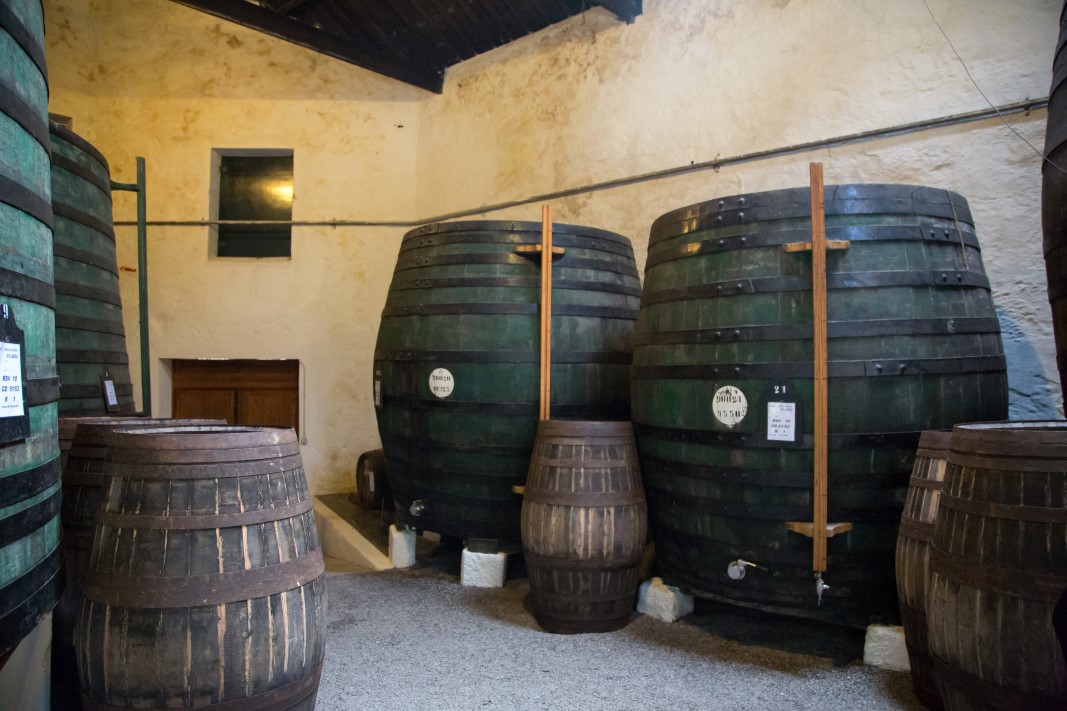
GS6A1748GS6A1750Taylor’s have a serious and stunning amount of large vats.

GS6A1752GS6A1753These vats hold around 6000 to 16000 Litre of port.

GS6A1754GS6A1756As long as the lodges are, just as long are the endless rows of casks.

GS6A1757The largest vat in Vila Nova de Gaia, holding in about 100000 Litre of port.

GS6A1759A view from the terrace around the bar. A view of the roofs of the many Taylor’s cellars.


Offley Colheita Porto 1997

GS6A5674Read all about Offley here: Visiting Offley in Porto

I was given this 750 ml bottle at 20% as a present, but it was bought in a Danish super market.

Red with brown notes in the colour, a deep amber and wood shine to it.

The aroma comes off with a heavy dried fruit scent and some alcohol makes it way through.

Spiced flavours, some tannin, different dried fruits in the taste that develops into a distinct  raisin in the after taste.

Overall rating 88 / 100

Visiting Offley in Porto

GS6A1761

Offley was founded in London in 1737 by William Offley, the company started out as a wine merchant, Offley was soon exporting wines and later began to produce its own Porto Wine.

Joseph James Forrester joined the company in the 1830’s and his entire adult life in Portugal was devoted to the Douro river and Porto Wine. Forrester was the first to chart the Douro River and Valley, an accomplishment that earned him recognition from and entry into various European Geography and Art societies.

Sogrape Vinhos merged with Forrester & Cª., Holder of Offley.

GS6A1762

Offley have very long and what seems to be endless cellars of casked port.

GS6A1764Some of the tunnels have a slightly lower temperature than those under the wooden roofs.

GS6A1765GS6A1766The large vats with 13000 Litre of Tawny port in each.

GS6A1767More casks with Tawny port.


Kopke Colheita Porto 1984

GS6A6046

Kopke was established in 1638 by Christiano Kopke and his son, Nicolau Kopke. The company was sold to the Bohane family, by the end of the 19th century, who tried to run it from London. The distance and the two World Wars disabled the control of the Company and they decided to sell it. In 1953 the Barros family bought the House of Kopke. In June 2006 it was sold and became a part of the SOGEVINUS Group.

I bought this 750ml bottle at 20% in Rema 1000 supermarket in Odense, Denmark at the price of 25 Euro.

This Kopke Colheita 1984 was bottled in 2014.

Brown colour with glaring stars of red in the tincture when seen against the candle.

Spices, dried fruits and a warm alcohol in the aroma.

A little bite from the tannin, warm and with some oak in the taste. A good dried fruits taste, sweet with raisins in the after taste that lasts a good while.

When first uncorked it is dominated by the alcohol and needs to breathe, no decanting, just needs to sit for half a day in bottle with level under the neck. That really works wonders on this cheap and to the price surprisingly good colheita, it mellows quickly over a few days, so enjoy it 1-2 days after opening.

Overall rating 89 / 100

Croft Vintage Port 1966

The two bottles as they looked straight from the cellar.
GS6A3357

Cleaned from dust.
GS6A3359

First bottle in the decanter.
GS6A3361

A rather large amount of residue at the bottom of the bottle.
GS6A3360

A beauty as the wine sits there in the decanter.
GS6A3363

Swirling the wine around before the first taste.
GS6A3365

Decanting

The cork was moist almost all the way through, fell completely apart when opened.

Colour is light red with brown notes to it.

Spiced dried fruits in the aroma with a slightly dominant alcohol.

Soft taste, low tannin, warmth spreads, long after taste of dried fruit.

I let it decant for  2 hours before it was returned to the bottle for serving later at a family dinner.

8 hours after decanting

Alcohol is less dominant in the aroma and the taste have come more together. There is a good and delicious play between tannin, warmth and the sweet fruit.

2 days after decanting

Velvet soft drinking experience as tannin goes smooth hand in hand with a spiced flavour of dried fruits and in the after taste I feel the taste of eating red grapes or the faint smell of a old oak cask.

This 48 year old wine really develops through the 48 hours I had it opened. A few good evenings with a few glasses at day one and two after decanting was really a pleasure.

Overall rating 93 / 100


Offley Boa Vista Vintage Port 1999

GS6A3308

Read all about Offley at: Visiting Offley in Porto

I bought this vintage port in a local supermarket in Odense, Denmark, it was on offer at 30 Euro. 750ml bottle at 20,5%.

It is only 13 – 14 years old and is properly still too young.

The colour is dark red almost bordeaux.

Taste notes 1 hour after decanting.

Weak fruit to the aroma that is dominated by the alcohol.

Tasting is dry, warm, tannin and some unbalanced notes that almost made me think it was a little corked.

Taste notes 24 hours after decanting.

The dried fruit shines more through in the aroma and alcohol is less dominant.

The taste still have a dry heavy start from the tannin and a great warmth. The unbalanced mentioned earlier is gone and a good after taste finishes it.


It should properly get some more years in the cellar, it lacks the complexity in the taste and a balance in aroma and taste.

Overall rating 87 / 100

Cálem – Late bottled vintage 2007

GS6A1791From left to right: LBV2007, LBV1997, 20 year Tawny and Fine Ruby.

To learn more about Cálem, read my article from visiting the wine producer: Visiting Calem in Porto

I tasted this late bottled vintage 2007 port at Cálem in Porto, Portugal.

Colour is a deep purple that could go right into black.

The aroma have a weak fruit to it.

The taste is dry with a fresh fruit to it. A weak dried fruit to the after taste, no other notes to it. It needs more time on the bottle. Cálem LBV wines are semi filtered so it can age and will get better with time.

Overall rating 84 / 100

Cálem – Late bottled vintage 1997

GS6A1791From left to right: LBV2007, LBV1997, 20 year Tawny and Fine Ruby.

To learn more about Cálem, read my article from visiting the wine producer: Visiting Calem in Porto

I tasted this late bottled vintage 1997 port at Cálem in Porto, Portugal.

Colour is a deep red with brown notes to it.

The aroma is a good dried fruits.

The taste is sweet with a long after taste of dried fruit and a subtle oak.

Overall rating 87 / 100

Dow – Porto Vintage 1986 Quinta do Bomfim

GS6A2621

Decanted at ten in the morning on Christmas day, the last centimetre of the bottle was residue.

Taste notes just after decanting.

A dark rose with brown notes in the colour.

A subtle fruit to the nose with a dominating alcohol.

Some tannin, very soft, very sweet and goes straight to a sweet overdose after taste of dried fruits. Seems a bit out of balance with the tannin.

Taste notes 8 hours after decanting.

The taste seems to be more in balance between tannin, hotness and sweetness than right after decanting.

Taste notes 1,5 days after decanting.

The dried fruit in the taste comes at once and the hotness takes over for a little while and a lovely long after taste of dried fruits follows.

Taste notes 2,5 days after decanting.

Aroma is no longer dominated by the alcohol but shares it evenly with the fruit.

Dried fruits, some tannin, hotness and then the dried fruits after taste, the wine does not seem to change much since 8 hours after decanting.


Overall rating 88 / 100